Building Your Airport
Melbourne Airport is building a third runway, which will deliver much needed aviation infrastructure capacity for Victoria and help support thousands of new jobs.
37,000
additional jobs by 2046
$3 billion
project cost
2031
opening
Runway approved
Early works commence
Community Health Study Terms of Reference submitted to Federal Government
Noise Sharing Plan development and engagement begins
Draft Noise Amelioration Plan and Program submitted to Federal Government
Main construction works begin
Detailed airspace design finalised
Operational readiness and testing of the third runway
Runway opens
Post-opening completion works continue
Frequently asked questions
Our third runway will deliver much needed aviation infrastructure capacity for Victoria and help support thousands of new jobs. Read more of our frequently asked questions.
The parallel runway system will significantly increase Melbourne Airport’s capacity by allowing for simultaneous take-offs and landings, which will help reduce delays, encourage growth and facilitate competition between airlines. It will ensure we have adequate capacity to serve Victoria’s needs for decades to come and will benefit Victorian travellers and exporters. With more than 76 million travellers expected by 2042, it's important we plan for this demand.
Early works activities ahead of construction will begin in 2025, with planes expected to be landing on the runway by 2031.
The new runway will be 3,000m long and will be constructed 1.3 kilometres to the west of the current north-south runway. The existing east-west runway is currently 2,286m long and, as part of construction, it will be shortened by 346 metres from the western end. However, as part of noise-sharing measures, the eastern end of the runway will later be extended by the same amount.
Airports by nature are busy, noisy places that can impact neighbouring communities. When the new runway is operational residents close to the approach and departure flight paths will notice more aircraft flying overhead. Suburbs very close to the airport, particularly Keilor and Bulla, will experience the most noticeable changes. Melbourne Airport is preparing a Noise Sharing Plan that will outline how the airport will share and lessen noise for nearby neighbours.
We are currently developing a Noise Amelioration Plan & Program in consultation with key stakeholders. This could include improvements like double-glazing windows, upgraded vents and seals, and acoustic insulation for eligible homes, schools, childcare and healthcare facilities. The boundaries of the plan, which will be defined by noise forecasts. Consultation on the plan’s scope will begin in 2025, and we’ll submit the final plan to the Federal Government for approval in 2026. Once approved, eligible property owners will be contacted directly.
Community pop-ups
We're currently in our local communities for public exhibition of our preliminary draft Master Plan 2027.
You can contact our team any time at newrunway@melair.com.au.
Environment
To learn more about the environmental considerations of the third runway project, visit our Environment page.
Construction works
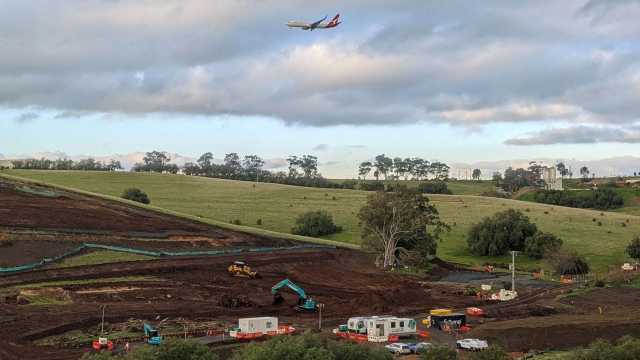
Early works are underway on the third runway, including upgrades to Sunbury Road to ensure safe entry and exit for construction vehicles entering and exiting the airport at the northern entry.
For updates and information, visit our Disruptions page.
Community Consultation
While the third runway has been approved by the Federal Government, there are still opportunities for community to get involved on various aspects of the project. Learn more about the various workstreams underway and how and when you can have your say by clicking the illustration below.

News and Resources
Environment
We recognise the importance of taking an environmentally responsible approach to meeting growing aviation demand.
This responsibility shapes how we’re designing and building our third runway at Melbourne Airport, including how we consider environmental impacts and long-term outcomes for surrounding communities.
We have made extensive efforts to reduce the environmental impacts of the new north-south runway. However, the project will affect some ecologically significant areas across the airport estate.
Grey Box Woodland
Overview
The third runway project requires clearing a section of the Grey Box Woodland, which is located at the northern end of the airport.
Essential clearing works will include areas of the Woodland that provide foraging habitat for the Swift Parrot. Some clearing works are expected to occur during the Swift Parrot’s migratory season due to construction timing requirements and the need to minimise impacts on other native species. There will be qualified ecologists on site to ensure impacts on fauna are minimised.
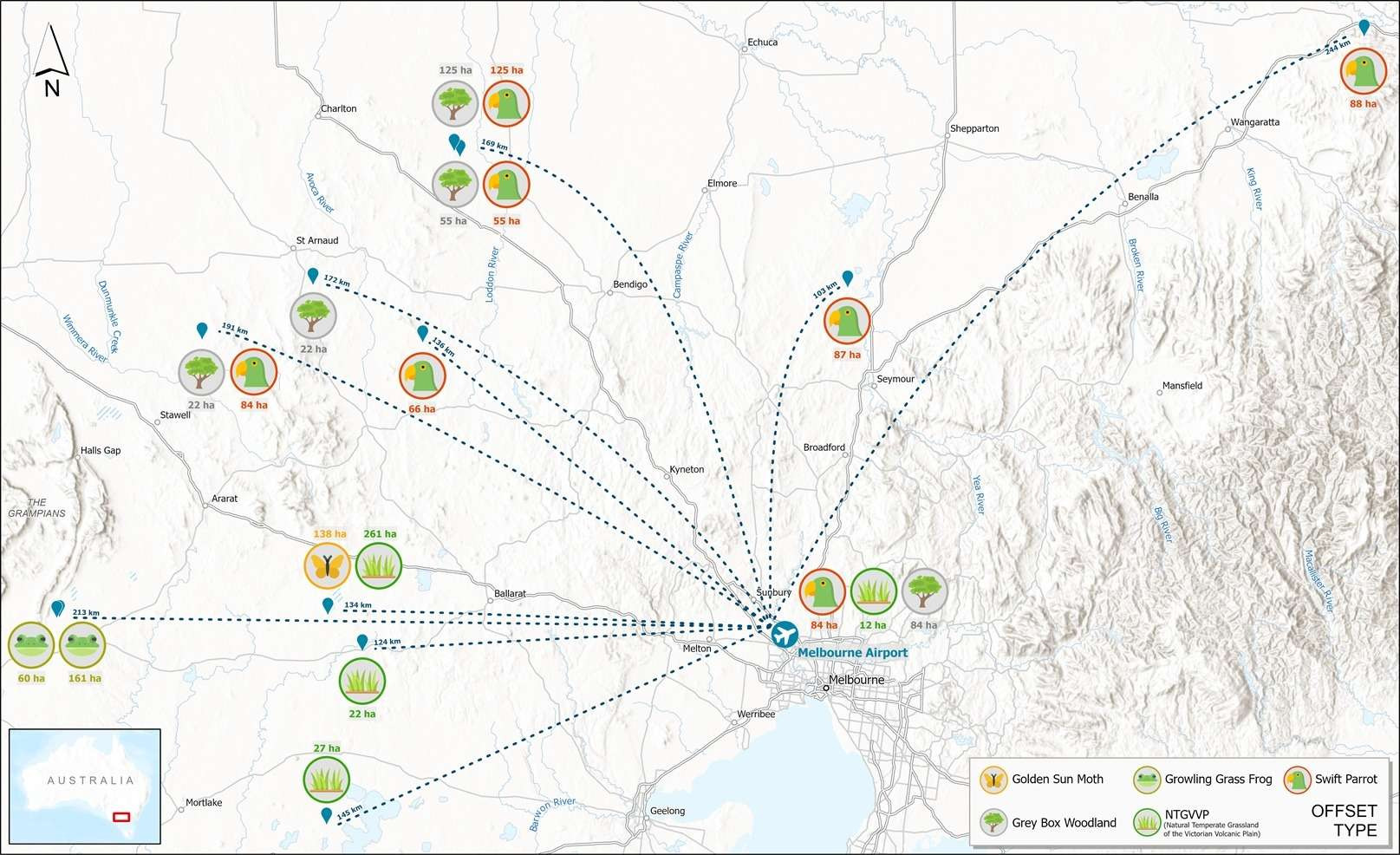
More than half of the Grey Box Woodland – approximately 83 hectares – will be retained and protected permanently as an onsite offset site. We’ll also deliver habitat improvements through an offset management plan that includes initiatives such as installing a predator-proof fence, strategic revegetation to improve food resources for fauna, and reusing cleared vegetation to create habitat for fauna.
The remaining impacts will be managed through offsite offset sites that help preserve Grey Box Woodlands around Victoria, and other habitats for the Swift Parrot.
Frequently Asked Questions
Despite significant efforts in the design of the third runway to minimise impacts on local flora and fauna, some disturbance to the western end of the Grey Box Woodland is unavoidable. This is because this section of the Woodland falls within the project footprint.
Selective clearance of the Grey Box Woodland will take place between June 2026 and September 2026 in line with government approvals. These clearing activities will allow construction to begin on the third runway.
While the total cleared area will be around 79 hectares, more than half of the Woodland, around 83 hectares, will remain permanently protected.
More than half of the Grey Box Woodland – approximately 83 hectares – will be retained and protected permanently.
There will be habitat improvements to the retained area of the Grey Box Woodland, which we’ll deliver through an offset management plan.
This plan includes initiatives such as installing a predator-proof fence around retained areas, strategic revegetation to improve food resources for fauna and reusing cleared vegetation to create habitat for fauna.
You can find this offset management plan on our Construction and Environment Reports page here.
We’re working to minimise impacts on flora and fauna during clearing activities where possible. Initiatives to reduce impacts include:
· Implementing comprehensive Construction Environmental Management Plans outlining how potential impacts will be prevented, controlled or mitigated, and monitored
· Incorporating key ecological information in worker inductions to ensure awareness of project requirements to protect flora and fauna
· Having qualified ecologists conduct pre-clearing surveys to identify potential habitat features that may require additional management or monitoring during clearing
· Having qualified ecologists present during clearing to manage and relocate fauna in accordance with industry best-practice
· Reusing cleared vegetation, such as hollow logs, to create habitat for fauna in the retained Grey Box Woodland
· Strategic revegetation to improve food resources for the Swift Parrot
· Installing predator-proof fencing around retained Grey Box Woodland areas
· Fencing off retained vegetation and habitat to ensure construction activities are limited to the approved areas, with daily inspections to maintain integrity
· Implementing controls to prevent the introduction and spread of pests and weeds.
Where possible, we'll use the remaining cleared vegetation, such as hollow logs, to improve habitat in the permanently protected section of the Grey Box Woodland on Melbourne Airport land.
View a map of the offset sites below:
PFAS
Overview
Per- and poly- fluorinated alkyl substances (PFAS) are manufactured chemicals used to make products resistant to heat, stains, grease and water. These chemicals are unique because they do not break down easily.
Firefighting foams containing PFAS (known as Aqueous Film Forming Foams or AFFF) were historically used by third-party operators Melbourne Airport – and other airports around Australia – because of their effectiveness at putting out liquid fuel fires.
The third runway project is being carefully managed to reduce environmental risks from legacy PFAS contamination on the site of the third runway. Find out more about our approach to managing PFAS-impacted land and soil.
You can also view Airservices Australia's PFAS Hub.
Frequently Asked Questions
Firefighting foams containing PFAS chemicals have been stored in aircraft hangers and used extensively by operators at Melbourne Airport for training for and responding to firefighting emergencies involving liquid fuels.
These products were used for both operational and training purposes until 2010.
We’ve developed a PFAS Management Plan relating to the third runway project, which has been approved by the Federal Government.
The plan includes initiatives such as:
• Safely reusing PFAS-impacted soil within the project as fill material, supported by appropriate controls to ensure it is managed safely and responsibly
• Diverting surface water runoff from high-PFAS impacted areas, improving water quality runoff where possible, and installing sediment controls to limit soil movement
• Managing areas where PFAS has previously been used or found.
Foams containing PFAS have been stored and/or used at several locations within the airport, including the following sites leased by Airservices Australia:
The current and former fire training grounds located in the north-west corner of the airport.
The Melbourne Airport Fire Station, Learning Academy Hot Fire Training Ground and Smoke Hut located in the central portion of the airport, to the west of the main north-south runway.
A Satellite Fire Station and Hangar/Maintenance Area located to the east of the main north-south runway.
Most people are exposed to low levels of PFAS, which is usually from eating food or drinking water with PFAS in it.
Victoria’s Environment Protection Authority states this is unlikely to be harmful to health but recommends that as a precaution, people reduce their exposure to PFAS.
Studies of human populations that have been exposed to PFAS at their workplace or in the environment have not provided definitive or consistent results.
Possible links between PFAS exposure and some health effects have been reported in some studies, but other studies have not identified any effects.
In studies where large doses of PFAS are given to laboratory animals, possible effects on the immune system, liver, reproduction, development and benign (non-cancerous) tumours have been identified.
However, PFAS behaves differently in the bodies of animals compared to humans, so effects shown in animals may not occur in humans.
We monitor PFAS contamination through our ongoing environmental monitoring program. For the third runway project, surface water quality monitoring – which includes PFAS monitoring - is conducted at more than 20 locations both on-airport and off-airport.
This is conducted at minimum quarterly. Extensive soil contamination assessments have also been completed across the third runway disturbance footprint, to inform the third runway PFAS Management Plan.
The Airports Act 1996 and the Airports (Environment Protection) Regulations 2026 (the Regulations) are two of the primary pieces of environmental legislation that apply to Melbourne Airport.
The Airport Environment Officer is the representative of the Department of Infrastructure, Transport, Regional Development, Communications, Sport and Arts (DITRDCSA) responsible for monitoring Melbourne Airport’s compliance with the Regulations, including PFAS.
Arundel Creek Treatment Facility
Overview
We're building a new water treatment facility beside Arundel Creek at the southern end of the airport site.
This facility is designed to ensure that rainwater that flows off our planned expansion projects, including the third runway, is treated before it reaches local waterways.
The facility will collect water runoff from the Arundel Creek catchment on Melbourne Airport land, improve its quality using sediment basins and natural filters, and then safely release it into the creek following government-approved standards.
This process removes increased sediment loads to help keep our rivers healthy. It will operate alongside other water treatment facilities already in use at Melbourne Airport.
Frequently Asked Questions
As the airport grows, including a new runway, new taxiways and new roads, more rainwater will run off these hard surfaces, picking up dirt and pollutants along the way.
The Arundel Creek Treatment Facility will ensure this water is improved to the required standards before it reaches local waterways.
By managing stormwater volumes and enhancing water quality, the facility will play a crucial role in protecting downstream ecosystems and ensuring compliance with environmental regulations during construction and operation of the third runway.
The facility will collect water runoff from the Arundel Creek catchment within Melbourne Airport land, improve its quality using sediment basins and natural filters, and then safely release it into the creek – all following government-approved standards.
This process removes pollution and increased sediment loads to help keep our rivers healthy. It will operate alongside other water treatment facilities at Melbourne Airport.
The facility has been designed to fit in with the local environment. It has been carefully placed to avoid disturbing Arundel Creek and nearby plants and vegetation as much as possible.
It also includes features to support habitats for native animals such as the Growling Grass frog. The facility is positioned to reduce the risk of attracting birds near the airport’s runways, which helps keep flights safe.
The facility is set to begin operating in mid-to-late 2027, following an approximately 12-month construction period.
Reducing environmental impacts
We’re committed to minimising environmental impacts throughout the design and construction of the third runway. Click the tabs below to find out how.
We’ve prepared and published detailed Flora and Fauna Environmental Management Plans for each phase of the third runway project.
The aim of these Plans is to detail how we’ll avoid, mitigate and manage the environmental effects of construction activities, including impacts on biodiversity and habitat.
View our third runway Flora and Fauna Environmental Management Plans below:
Find out more about flora and fauna considerations of the third runway project in this fact sheet.
Offsets are a key requirement of the third runway project under federal legislation and help compensate for unavoidable environmental impacts.
The offset process includes:
Securing land at on-site and off-site locations
Managing that land to improve its ecological condition and protecting it for the long term.
The offset program includes two on-site offset areas and several other off-site locations within Victoria. See a map of these locations below.
There will be additional CO₂ emissions associated with the construction of the third runway.
To minimise these emissions during the five-year construction period – as well as reduce waste generation and materials consumption – we’re investigating the feasibility of:
Reusing onsite material where possible during the construction of the third runway
Using low-carbon concrete and supplementary cementitious materials to reduce the environmental impact of concrete production during construction works
Increasing the use of recycled steel where possible and reducing overall steel consumption through the use of alternative reinforcement materials such as polymer and fibre
Using local sourcing strategies, including materials from local suppliers, to reduce transport distances to the third runway site
Using more recycled content in asphalt or warm-mix asphalt over hot-mix asphalt where appropriate to reduce the carbon footprint of flexible pavements
Better management of site works to reduce transportation emissions
Using electric vehicles and alternative fuels in the construction process, where appropriate
Recycling waste streams for construction waste.
Other sustainability initiatives at Melbourne Airport
In addition to the specific third runway-related environmental programs, we’re implementing a number of initiatives to improve our environmental performance and minimise the impacts of our current and future operations.
In 2021, we started operating our first solar farm, a 12-megawatt (MW) facility at Oaklands Junction under the approach to the north-south runway.
The solar farm is 16 hectares in size and is the largest solar installation at any airport in Australia.
In 2025, we commissioned our second solar farm. The North Airfield solar farm produces an additional 7.5 megawatts of energy and sits adjacent to our existing Oaklands Junction solar farm on the corner of Sunbury Road and Oaklands Drive. It comprises around 20,000 solar panels.
Together, the solar farms generate around 34 gigawatt-hours (GWh) of energy per annum. This is enough energy to power terminals 1, 2, 3 and 4.
We achieved net-zero for Scope 1 and Scope 2 CO₂ emissions through a comprehensive, airport-wide program in 2025.
Ongoing energy efficiency upgrades and on-site solar energy generation are directly reducing our reliance on non-renewable energy sources.
Melbourne Airport continues to be powered by renewable energy, sourced from both on-site solar generation and a power purchase agreement established in 2024. We’re also progressing the electrification of our vehicle fleet.
We purchase high-quality carbon offsets to further reduce our CO₂ footprint with a preference for environmental planting projects.
Find out more here.
Construction and Environment reports
View our third runway-related Construction and Environment Reports.
Related pages
Disruptions and Updates
Stay updated with construction activities that may impact local residents and people travelling to and from Melbourne Airport.
Community Health Study
We’re undertaking a world-first long-term study into the potential health impacts of aircraft noise on communities surrounding Melbourne Airport.
Construction
Learn about the key construction phases of the third runway project. If you've got questions, you can always come see us at one of our community pop-ups or contact us. Stay up-to-date with any planned changes and disruptions online.
Before main construction on the project begins in 2026, there are several early and preliminary works activities that take place.
Melbourne Airport is making changes to Sunbury Road at the north of the airport. These roadworks are in preparation for construction of the third runway, to allow for safe entry and exit of trucks and vehicles onto airport land.
This will cause disruptions for traffic, and we apologise for the inconvenience. We are sharing information about delays, changes and disruptions.
To build the third runway, we will excavate around five million cubic metres of material. This material needs to be excavated so that we can create the flat platform required for the runway, and it will then be re-used onsite.
The area where the future runway is located also contains rocky regions. While much of the material can be removed using earthworks equipment, some will require different methods – including blasting.
We undertook a small-scale blasting trial in October 2025 to check our proposed methodology. The results of this trial will then inform our main works when they commence in 2026. This trial involved two controlled blasts on two separate days. The blasting site was inside the airport boundary, more than 1.4 kilometres from the closest resident in Bulla, and we notified local residents ahead of the trial. You can read more in the fact sheet below or watch this short video.
The Arundel Creek Treatment Facility is a new water treatment system being built as part of Melbourne Airport’s third runway. The facility is an end-of-line stormwater treatment system that will be located near the southern boundary of the Melbourne Airport estate. Its main job will be to clean and treat stormwater before it leaves airport land. You can read more about the facility and its role in the fact sheet below.
Main construction
In 2026, Melbourne Airport will begin main construction works, including the major earthworks required to level the site for the runway and taxiways. This work will take several years, with the runway opening in 2031.
During construction, temporary changes will be required to some airfield operations to allow for the installation of connecting taxiways and runway crossing points, as well as changes to the east-west runway. Any changes to existing runway use that alter the way flight paths are used will be communicated to the community and other stakeholders before they occur, as some communities will experience an increase or decrease in aircraft noise over the course of the project.
Construction considerations
A study into the Indigenous cultural heritage of the third runway site has been conducted, and a Cultural Heritage Management Plan (CHMP) developed. The Wurundjeri Woi-wurrung Cultural Heritage Aboriginal Corporation has approved the CHMP. This plan includes working in consultation with the Wurundjeri Woi-wurrung to determine how to excavate and manage items of significance if they need to be disturbed by the project.
A total of 17 Aboriginal places were identified within the third runway footprint. Melbourne Airport is completing a process of archaeological salvage to collect and record archaeological deposits, to comply with the approved CHMP.
In addition, Melbourne Airport identified 10 European heritage sites within the third runway footprint that will be directly impacted by the development. These sites relate to early European settlement in the Tullamarine area, most from mid to late 19th century. Impacts will be mitigated through archaeological salvage and recording.
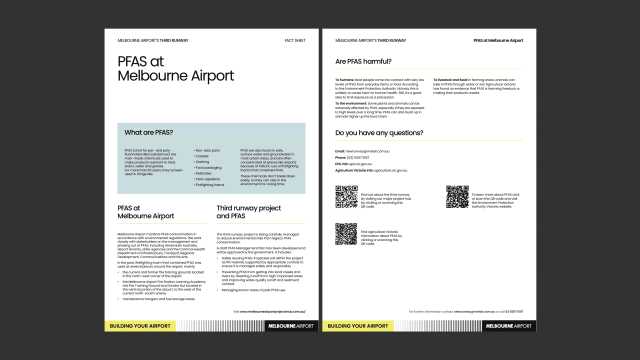
Per- and polyfluorinated alkyl substances (PFAS) are man-made chemicals used for decades in products like non-stick cookware, carpets, clothing and firefighting foams. PFAS are commonly found in soils and water, especially at sites like airports where firefighting foams were historically used.
At Melbourne Airport, PFAS contamination is closely monitored and managed in line with environmental regulations, in collaboration with stakeholders such as Airservices Australia, airport tenants and government agencies.
As part of the third runway project, Melbourne Airport has developed a government-approved PFAS Management Plan to minimise environmental risks from legacy contamination. This plan includes safely reusing PFAS-impacted soil within the project, preventing runoff into local waterways and managing known areas of past PFAS use. Read more in the fact sheet below.
Communications
Melbourne Airport will ensure continued communication with stakeholders throughout the construction period. You can read about the communications and engagement approach in the Third Runway Construction Communications Strategy.
Complaints
Contact Us
Have a question about the project which isn't answered elsewhere or would you like to provide comment or feedback? Send us an enquiry using the form on this page.