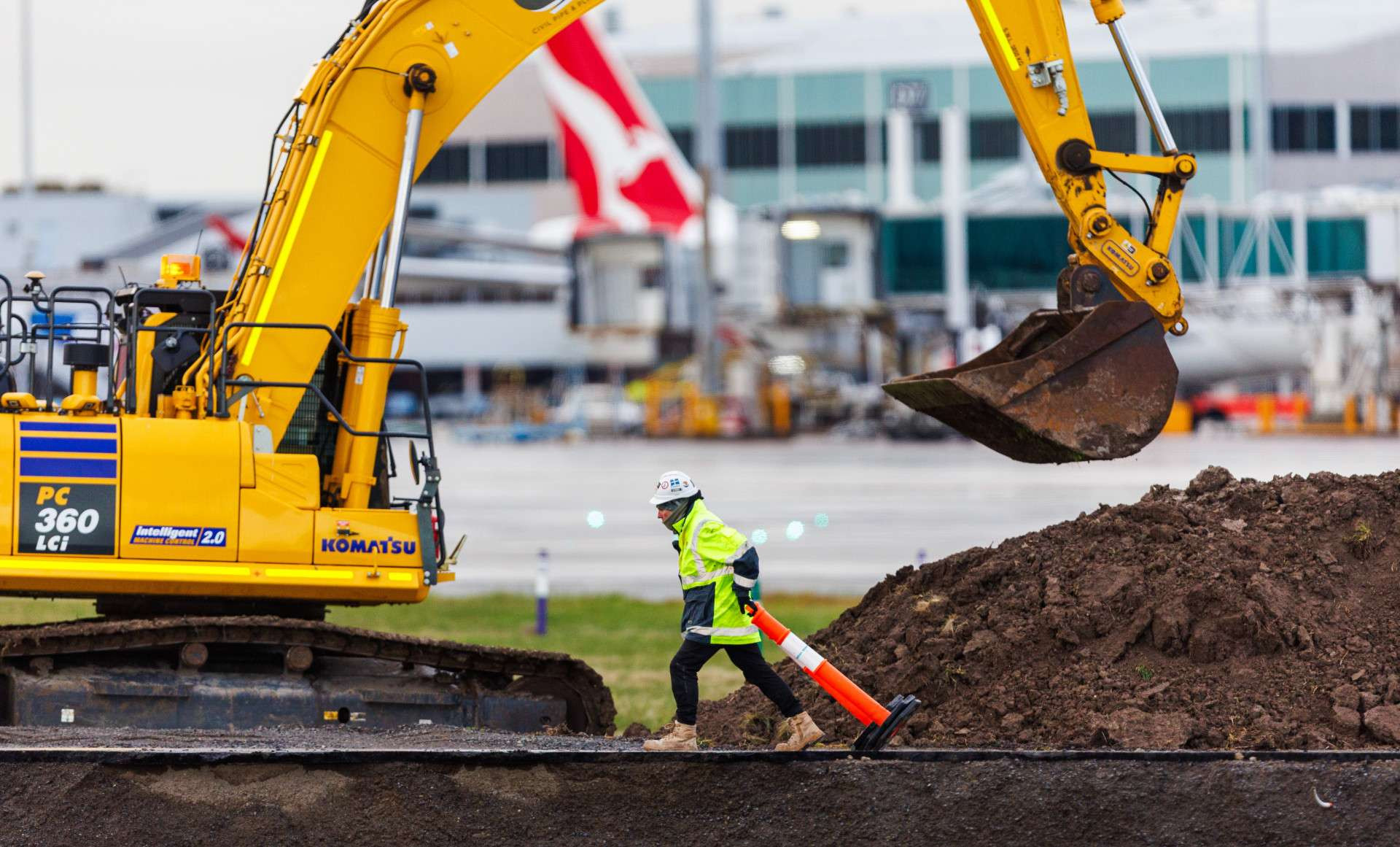
Melbourne Airport is Australia's busiest 24/7 international airport, connecting Victoria to destinations across the globe. December 2025 was our busiest month ever, with more than 3.4 million people moving through our terminals. As Melbourne and Victoria continue to grow, we're expecting passenger numbers to reach around 76 million travellers a year by 2042. Growth on this scale requires careful planning, and that's why we're building a third runway.
Due to open in 2031, Melbourne Airport's Third Runway Project is a $3 billion, privately funded development that will support the growing demand for air travel in Melbourne and across Victoria. The new runway will run parallel to the existing north-south runway, increasing capacity and allowing simultaneous take-offs and landings. Because it’s a major construction project, there's a lot of change that comes with it. Below, we’ve put the key facts together, so you can understand what’s changing at Melbourne Airport and what it means for the years ahead.
Why Does Melbourne Airport Need a Third Runway?
Melbourne Airport needs a third runway because its current two-runway system is reaching capacity. With passenger numbers expected to reach 76 million by 2042, roughly double today's numbers, the existing runways won’t be able to meet demand. Right now, only one aircraft can use the north-south runway at a time. A parallel runway system changes that, allowing simultaneous take-offs and landings, significantly increasing capacity and improving the efficiency of air traffic at Melbourne Airport.
Melbourne Airport's 20-year Master Plan has long identified a third runway as the right response to Victoria's growing demand for flights. If you've been delayed on the tarmac waiting for a gap in the schedule, you've already experienced a constrained runway system.
A few factors make this particularly urgent:
The current runway system was built for a different Melbourne. The airport has been operating on the same runway layout since it opened in 1970. Melbourne has grown significantly since then, and the infrastructure designed for a much smaller city is now under increasing pressure.
The existing runways intersect. When one runway is in use, it limits how the other can operate. That operational dependency reduces the number of flights the airport can process at any given time, and it becomes more challenging as demand increases.
Melbourne is the only major city without a parallel runway system. Both Sydney and Brisbane have operated parallel runway systems for years. Without one, Melbourne is at a disadvantage within the broader Australian aviation network.
Peak periods are already under strain. Delays that build early in the day can affect hundreds of flights by the afternoon. Without a parallel runway system, that problem only gets worse.
Limited capacity affects competition. Without the capacity for more flights, airlines can't compete as freely, which means fewer route choices and higher fares for travellers.
It impacts freight and the broader economy. Victorian exporters rely on this airport too. Capacity constraints can slow freight movement and push up costs for businesses across the state.
Where Will the Third Runway Be Built and How Big Is It?
The new runway will be built 1.3 kilometres to the west of the existing north-south runway at Melbourne Airport. It will run parallel to the existing runway and extend 3,000 metres in length. New taxiways will connect it to the rest of the airfield. To make room for the new runway, the existing east-west runway will be shortened by 345 metres at its western end, bringing it from 2,286 metres down to 1,940 metres.
The project was approved by the Federal Government under Section 94 of the Airports Act 1996 in September 2024. One of the conditions of that approval is that the eastern end will later be restored to its original length through the Eastern Extension Project. This will give the airport more flexibility for managing aircraft noise across surrounding communities once all three runways are operating.
When Does Construction Start and When Will the Third Runway Open?
Main construction works on Melbourne Airport's third runway are set to begin in 2026, with the runway expected to open in 2031. Getting here has taken years of careful planning, environmental studies and community engagement. Before any work could begin at Tullamarine, the project underwent a lengthy public consultation process and a rigorous Commonwealth Government assessment.
Here’s what the Third Runway Project timeline looks like:
2022 – Melbourne Airport placed the draft Major Development Plan on public exhibition for 104 days. More than 50 community engagement sessions were held, over 2,100 submissions were received from residents and stakeholders, and newsletters were distributed to 1.2 million households near the airport and its flight paths.
2024 – The Federal Minister for Infrastructure, Transport, Regional Development and Local Government formally approved the Major Development Plan on 10 September 2024 under Section 94 of the Airports Act 1996 (Cth), giving the project the green light to proceed.
2025 – Site preparations and geotechnical investigations got underway across the runway footprint in August 2025. If you use Sunbury Road, you may have noticed the upgrades at the northern entry, widening the road to allow access for construction vehicles.
2026 – Main construction works begin. The major earthworks programme gets underway, with around 5 million cubic metres of material excavated to create a level platform for the runway. That material is reused on site rather than removed.
2029 – Detailed airspace design is finalised.
2030 – Operational readiness and testing of the third runway take place.
2031 – The runway is expected to open, with post-opening completion works continuing beyond that date.
What Will the Third Runway Mean for Victoria?
The Third Runway Project will enable 136,500 additional aircraft movements to Melbourne Airport each year, support 37,000 additional jobs in Victoria by 2046 and contribute $5.9 billion to the Victorian economy annually.
Here’s what those figures mean in practice:
Work across Victoria during construction. Building the runway is expected to create around 10,700 direct and indirect jobs during construction. That's real work for contractors, trades and specialist service providers, spread across several years of activity.
Long-term employment across the state. Once operational, the airport is forecast to support 37,000 additional jobs in Victoria by 2046. That’s thousands of jobs across airlines, freight, logistics, ground handling, hospitality, and the many businesses that service the growing airport precinct.
A bigger annual contribution to the state economy. Melbourne Airport already generates nearly $22 billion in gross value added and supports around 239,000 jobs across Victoria. The new runway is forecast to add $5.9 billion to the Victorian economy every year on top of that.
More flights, more competition, more choice. An additional 136,500 aircraft movements each year means more capacity for airlines to operate, more routes to choose from and stronger competition on fares. If you fly regularly, that generally works in your favour.
Better conditions for Victorian exporters. Melbourne Airport accounts for around 37% of Australia's air freight exports, with goods worth $23 billion (FY24) moving through the airport each year. More runway capacity means more reliable access to global markets for the producers and businesses that depend on it.
More value from international connections. Each daily international service contributes around $190 million to the Victorian economy every year. More runway capacity gives us the ability to attract and sustain more of those services over time.
How Will the Third Runway Affect Flight Paths and Communities Nearby?
For communities close to the airport, the third runway means flight paths will change and more aircraft noise will be heard. Suburbs like Keilor, Bulla, and areas across Brimbank and Hume are expected to notice the most significant changes to aircraft noise. With 14 runway operating modes available once all three runways are operational, compared to 8 today, the airport will have significantly more flexibility to share and manage aircraft noise across surrounding communities.
Here is what that looks like in practice:
Flight paths are not yet finalised. The paths outlined in the approved Major Development Plan are a starting point, not the finished design. Airservices Australia will lead the detailed airspace and flight path design, with safety assessments and community input shaping the final outcome.
Noise won't increase everywhere equally. Some areas close to the new runway will hear more aircraft. Others may notice aircraft in different parts of the sky, and some will see little change. Suburbs like Keilor, which sit closest to the airport, and communities across the Brimbank and Hume local government areas are expected to experience the most significant shifts.
The Noise Sharing Plan aims to distribute that noise fairly. The Noise Sharing and Airspace Concept Plan is designed by independent consultants who aim to share noise across suburbs. By using a variety of runway operating modes, communities surrounding the airport will get periods of respite from aircraft noise, outside of peak periods and when conditions allow.
The Noise Amelioration Plan and Program will support eligible homes. If your home or a community building in Hume or Brimbank is eligible, the Noise Amelioration Plan and Program will fund practical upgrades, such as double-glazed windows and acoustic insulation, funded entirely by Melbourne Airport.
An independent Community Health Study will track the long-term impacts. We commissioned an independent Community Health Study as a condition of the project's approval, with health experts from Deakin and Liverpool universities leading the work. It will collect data on the health impacts of aircraft noise before the runway opens and for 20 years after.
What Are the Envioronmental Impacts of the Third Runway?
Melbourne Airport’s third runway is a major infrastructure project designed to meet the growing demand for air travel. While extensive efforts have been made to reduce environmental impacts, the project will impact several ecologically significant areas across the 2,740-hectare airport estate.
Some vegetation clearing is required for Melbourne Airport's third runway across areas that support native habitats and species. As part of our commitment to sustainable development, a comprehensive offset management program is in place to protect biodiversity and support long-term conservation outcomes.
Additionally, the third runway will contribute to increased annual greenhouse gas emissions. Once operational, total annual emissions are estimated at around 1,162 kilotonnes of CO₂-e, compared to 814 kilotonnes without it.
We recognise the environmental impacts of the project and are taking steps to reduce these impacts wherever possible. Here is what we’re committed to:
Reducing the emissions we can control. For the emissions directly within our control, covering construction activity and airport operations, we are committed to reducing them by 10 per cent below what they would otherwise be.
Replacing the habitats we clear. Construction will require some vegetation clearance within the airport precinct. To compensate, we are acquiring environmental offsets, securing land and managing it permanently to replace the native habitats and species that will be lost.
Protecting flora and fauna. We’re working closely with suitably qualified ecologists to manage and relocate fauna in accordance with industry best-practice, installing permanent predator-proof fencing around retained woodland, facilitating strategic revegetation to improve food resources for the Swift Parrot and implementing controls to prevent the introduction of pests and weeds.
Managing PFAS responsibly. The project includes a government-approved plan to manage PFAS chemicals, a legacy of historical firefighting activities on site, to prevent runoff into local waterways.
Stay Across the Key Facts as the Project Progresses
Melbourne Airport's third runway is a $3 billion, privately funded build due to open in 2031. It will bring 136,500 more aircraft movements each year, support 37,000 additional jobs in Victoria by 2046 and contribute an additional $5.9 billion to the state economy annually. The project comes with firm commitments on noise management, environmental impact and community wellbeing, all built into the Federal Government's approval conditions.
If you want to go deeper on any part of the project, the Third Runway Project page on the Melbourne Airport Projects Hub is the best place to start. You will find fact sheets covering specific topics, along with the option to sign up for updates so you hear about progress as it happens. You are also welcome to reach out directly at newrunway@melair.com.au or call (03) 9297 1597. Our team is always happy to help.