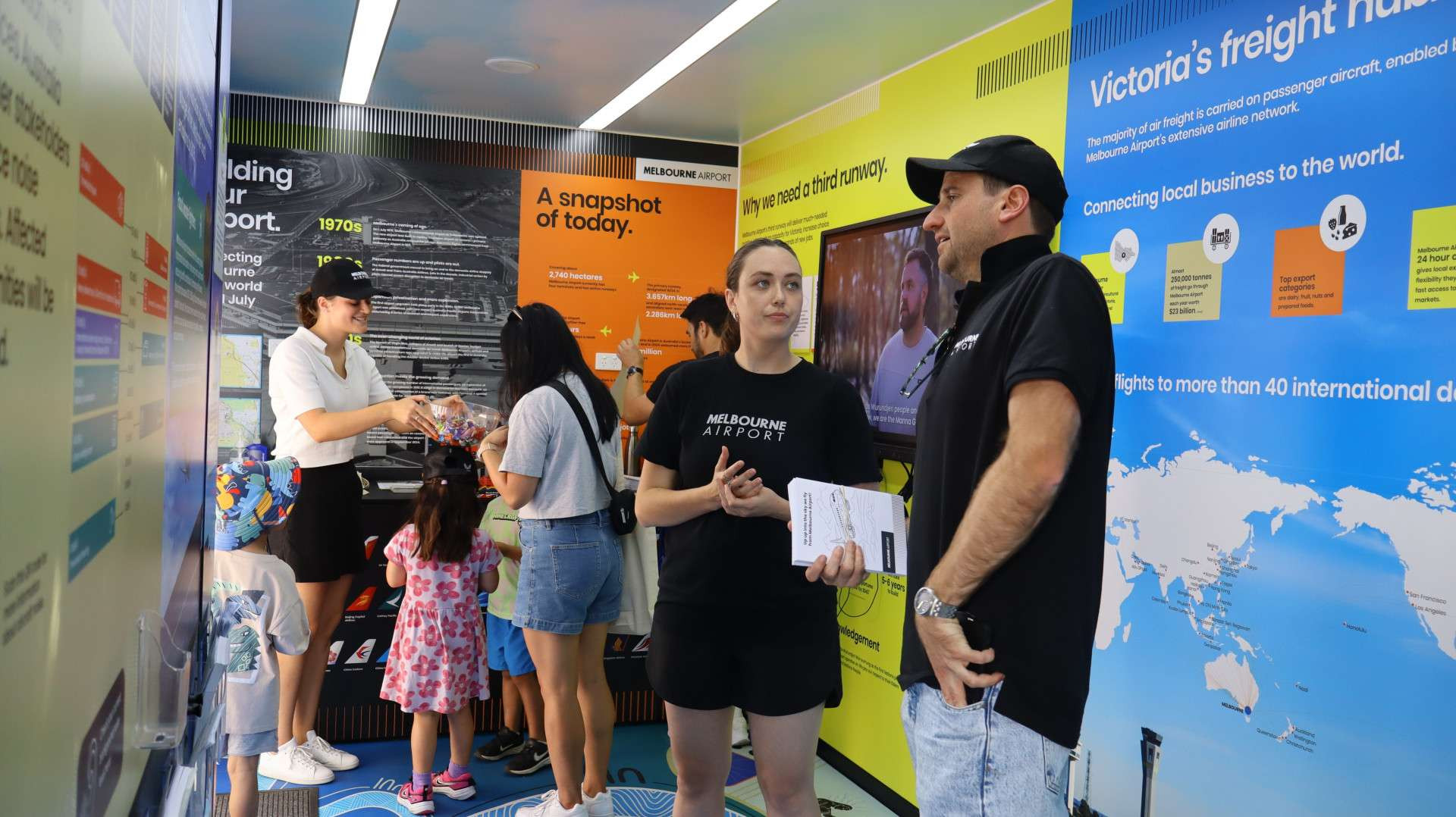
As Australia's busiest 24/7 airport, Melbourne Airport sees 36 million travellers through our terminals each year. By 2042, that passenger number is forecast to reach 76 million.
Our existing runway system wasn't built for that kind of demand. Our 20-year Master Plan identified Melbourne Airport's Third Runway Project, a privately funded, $3 billion build due to open in 2031, as the response to Victoria's growing passenger demand.
If you live near the airport, though, you're probably less interested in those figures and more interested in what changes for you. Some suburbs near Melbourne Airport will hear more flights when the runway opens, while others won't see much change at all. So what does all of this actually mean for your community?
Which Suburbs Near Melbourne Airport Will Experience the Most Change?
Keilor and Bulla are the suburbs closest to the new runway and the ones expected to experience the most significant changes when it opens in 2031. Both sit near the Tullamarine site where the runway is being built, 1.3 kilometres to the west of the existing north-south runway.
More broadly, residents across the Brimbank and Hume local government areas live closest to the airport, and these communities are central to our planning. Further into Melbourne's western suburbs, areas like West Footscray and Moonee Valley have also raised concerns about what new flight paths could mean for them.
Through public consultations with local communities and input from airlines, independent consultants Trax and GHD are working on the plan that will shape how Airservices Australia designs flight paths. The goal? That no single suburb carries all that activity every day. For people living near the airport, that means genuine periods of respite in your community when conditions and safety allow.
Will Flight Paths Change for Communities Near the Airport?
Yes, flight paths will change when the new runway opens. What you may have seen in maps and online tools so far is a concept design, not the final picture. The detailed design work takes time and follows a careful sequence of steps before anything is locked in.
Here's how that process works:
Independent consultants Trax Asia Pacific and GHD are preparing the draft Noise Sharing and Airspace Concept Plan, with community and airline input shaping it before it goes to the Federal Minister for Infrastructure, Transport, Regional Development and Local Government for approval.
Once the Minister approves it, Airservices Australia carries out the detailed airspace design, including safety assessments and operational checks to make sure everything works in practice.
The detailed airspace design is expected to be finalised by 2029, two years before the new runway is due to open.
The east-west runway is also part of what Airservices Australia designs around. Because it runs at a right angle to both north-south runways, it gives the airport more options for how aircraft can be routed in and out of Melbourne. The final flight path design takes all three runways into account as a connected system.
That's part of why the design process draws on input from right across the Melbourne Basin, including Essendon Airport and Moorabbin Airport, and why getting it right takes the time that it does.
What Does Melbourne Airport's Third Runway Mean for Local Communities?
Melbourne Airport’s Third Runway fact sheets tell us that the project goes well beyond runway construction. They cover aircraft noise and the plans to manage it, an independent 20-year health study for communities near the airport, and how we’re addressing the environmental impacts across greenhouse gas emissions, PFAS and local flora and fauna.
Aircraft Noise and How It Will Be Managed
For communities near Melbourne Airport, the third runway means real change beyond what they'll see in the sky. With 136,500 additional aircraft movements expected each year once the runway opens, the airport's reach into the local economy grows considerably.
Those extra movements feed into jobs, local businesses and the freight connections that keep Victorian exporters competitive.
For travellers, more planes taking off from Melbourne Airport means more airlines competing for your seat. That competition keeps fares lower. A parallel runway system allows simultaneous take-offs and landings, which is how the airport can handle more flights without the queuing that builds when planes share a single runway.
For local workers and job seekers, around 10,700 direct and indirect jobs are expected during construction. The airport forecast to support 37,000 additional jobs in Victoria by 2046, with much of this growth enabled by the third runway. Since the majority of people who already work within the airport precinct live nearby, a good portion of that opportunity stays local.
For businesses, more air traffic through the airport means more local spending on transport, accommodation and services. More runway capacity also helps reduce the scheduling delays that come from operating close to capacity.
For local exporters and freight users, Melbourne Airport handles around 40% of Australia's air freight exports. At close to capacity, a single disruption delays shipments across the board. More runway capacity spreads that load, giving Victorian producers and freight-dependent businesses a more consistent pipeline to global markets.
How Will Melbourne Airport Manage Third Runway Aircraft Noise in Nearby Communities?
As a condition of the Federal Government's approval of Melbourne Airport's Third Runway Project, independent consultants Trax and GHD are developing a Noise Sharing and Airspace Concept Plan to manage aircraft noise across surrounding communities.
With the new runway, the number of runway operating modes will increase from 8 to 14, which means more configurations for how aircraft arrive and depart. When conditions allow outside of peak periods, communities near the airport can expect genuine periods of respite from overhead activity.
Here's what the Noise Sharing Plan means in practice:
The plan doesn't mean every suburb gets the same amount of overhead aircraft noise. Some communities will hear more planes. Others will hear planes for the first time.
Safety, weather and demand always take priority. There will be days when those factors limit what noise sharing is possible. The plan works within those realities, not around them.
What it does commit to is that no single suburb carries all that activity on its own, day after day. The goal is rotation and genuine periods of respite across the communities closest to the airport.
Community feedback continues to shape the Noise Sharing Plan. More than 500 residents participated in consultation sessions, alongside input from airlines and industry stakeholders. That input goes into how the operating modes are designed and when they're used.
What Measures Are in Place for the Suburbs Most Affected?
Some properties in Brimbank and Hume, including homes, schools, childcare centres and healthcare facilities, may be eligible for acoustic improvements through the Noise Amelioration Plan and Program. It’s one of the Federal Government’s approval conditions, and eligible homeowners won’t cover the cost. We do.
In practice, here's what that looks like for eligible properties closest to the airport:
If your property qualifies, you may receive double-glazed windows, roof insulation, and upgraded door and window vents and seals. The specific treatment depends on what an independent acoustic assessment recommends for your property.
Eligibility is based on forecast aircraft noise levels once the third runway is operational, not current noise levels. Your property needs to fall within the ANEF 25 contour, which is the Australian government's standard measure for significant aircraft noise exposure.
The program covers buildings that existed before 14 November 2022. That's the date Melbourne Airport's 2022 Master Plan was approved, and the third runway's noise impacts were formally forecast. Properties approved after that date were planned with that information available, which is why they fall outside the program's scope.
Melbourne Airport will pay the accredited builders directly. Once the Federal Minister for Infrastructure, Transport, Regional Development and Local Government approves the plan, the team will contact eligible property owners.
The draft plan goes to the Federal Minister for approval in 2026. The program then runs for at least 10 years from that point, giving eligible property owners time to access it.
Alongside the Noise Amelioration Plan and Program, Melbourne Airport is also required to commission an independent Community Health Study into the health impacts of aircraft noise on surrounding areas.
No Australian airport has done this before. Health experts from Deakin and Liverpool universities wrote the terms of reference, and a separate independent team will carry out the research. Before the runway opens, they measure baseline data on the health impacts of aircraft noise. After it opens, the study runs for 20 years, tracking sleep disturbance, annoyance, communication interference and the effects of aircraft noise on children's learning.
Every year, those findings get published on our website and presented to the Melbourne Airport Community Aviation Consultation Group.
Shape What Comes Next for Your Community
Melbourne Airport's Third Runway Project brings real change to suburbs nearby, from shifts in aircraft activity overhead to new economic opportunity close to home.
The Federal Government's approval conditions include binding measures to manage the impacts: a Noise Sharing Plan to distribute aircraft noise across more areas of Melbourne, the Noise Amelioration Plan and Program to fund acoustic upgrades for eligible properties, and an independent Community Health Study that tracks health impacts for 20 years after the new runway opens.
The Melbourne Airport Projects Hub has fact sheets on the project’s approval conditions, construction and consultation timeline, and more. Sign up for updates to hear about progress directly, or head to the Have Your Say page on the Major Projects Hub website to know what's currently open for community feedback.
If you'd rather just talk to someone, email our friendly team at newrunway@melair.com.au or call us on (03) 9297 1597.